
This report provides a quantitative representation of the educational attainments and specializations of current female executives in the National Hockey League. By identifying the most common pathways to a career in the National Hockey League, including undergraduate institution rigor, undergraduate major, and graduate pursuits, this analysis strives to find an approximate “standard” for female executives. Definitively, findings from this study serve as a standard for the criterion needed to excel as a female executive in the National Hockey League.
Subjects in this study were identified through their respective organization’s front office staff listings. Females who had executive roles, roles as senior vice president or vice president, or assistant general manager were incorporated into this study. To determine their undergraduate institutions, undergraduate majors, and graduate pursuits, information was gathered from professional networking websites. To assess the rigor of the undergraduate institutions, the US News and World Report Education database was utilized.
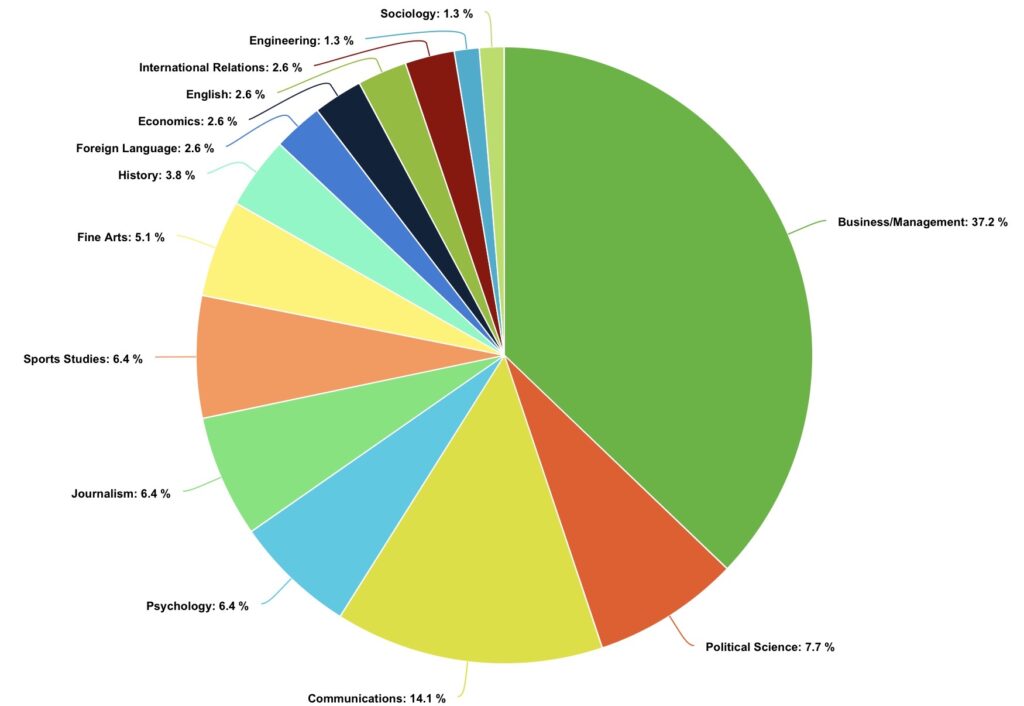
Out of 111 identified female executives, only 78 had an undergraduate institution listed in their professional networking profiles. 10 of the 78 institutions were located outside of the US, making the acceptance rates unknown. 9 of 78 females did not have an undergraduate major listed with their undergraduate institution, yet the prevalence of a double major option raised the amount of total, individual undergraduate majors to 78. Majors were categorized into 14 categories based on similarity.
The average acceptance rate of the undergraduate institutions attended by the current female executives is 53.2%, suggesting that attending a highly or hyper-selective institution is not essential to success in the National Hockey League. The most prevalent majors for current female executives are business/management related, with 37.2% majoring in such. Notably, 14.1% of the subjects majored in communications, and 7.7% majored in political science. A business/management related degree fixes the highest probability for hiring and success in the National Hockey League, yet in view of the fact that less than half majored in degrees as such, it is not essential to success.

Of those who completed an undergraduate education, 35.9% attended a graduate institution. 39.3% of those who continued their education received a Juris Doctor, and 21.4% received a master of business administration. 10.7% received a master degree in sports management. While receiving a graduate degree may be beneficial, it is not essential to success as a female executive in the National Hockey League.
All in all, there are many paths to success as a female executive in the National Hockey League. Attending an average undergraduate institution and majoring in a field similar to the prospect’s desired role will start a road to success for females looking to work in the National Hockey League. Completion of a graduate degree does not determine success, yet it aids to the chances of making it to an executive role.
| Name | Major | Institution | Postgraduate |
| Leah Leahy | Communication and Media Studies | Regis College | n/a |
| Amela Vautour | |||
| Andrea Mazzarelli | Bachelor of Arts | Holy Cross | n/a |
| Shannon Torgerson | BS, Media and Public Relations | Boston University | USC (MA, Marketing Communications Management, Public Relations), Northwestern University (J.D.) |
| Jamie Norton | n/a | n/a | n/a |
| Cara Murphy | BS, Early Childhood Education and Teaching | Canisius University | n/a |
| Allie Anneheim | |||
| Anna Stolzenburg | BA, Broadcast and Digital Journalism, Political Science | Syracuse University | n/a |
| Nicole Hendricks | Public Relations | University of Georgia | n/a |
| Lauren Cochran | |||
| Chantal Machabee | University of Montreal | Political Science and Government | n/a |
| Jacqueline Belsito | Business, Management, Marketing, and Related Support Services | Algonquin College | n/a |
| Elizabeth Frazier | |||
| Nicole Parente | BA, Psychology | University of South Florida | Hofstra University (MA, Industrial and Organizational Psychology) |
| Sheri Anderson | BBA, Marketing, Management | University of North Dakota | University of Central Florida (MBA) |
| Kelli Yeloushan | BA, Studio Art | University of South Florida | n/a |
| Andrea Murphy | |||
| Mandy Garner | BS, Accounting | Illinois State University | n/a |
| Jaime Faulkner | n/a | n/a | n/a |
| Therese Baird | Business Administration; Accounting | Texas A&M | n/a |
| Lindsay Dowdy | BA, Psychology | Texas Tech University | Texas Tech University (MBA, Management) |
| Kerry O’Dorisio | |||
| Chelsea Livingston | n/a | Texas Tech University | n/a |
| Joanne Lovato | BA, Sociology; Business Administration | UCLA | n/a |
| Carin Anderson | BS, Business and Finance | UMN Carlson | n/a |
| Kelly McGrath | BS, International Studies, French, Economics | University of St.Thomas | n/a |
| Kate Setley | Journalism and Spanish | University of Minnesota | n/a |
| Michelle Kennedy | |||
| Heidi Bundren | BBA, Business Admin and Marketing | University of St.Thomas | South Texas College of Law Houston (JD) |
| Courtni Mosley | English Literature | University of Tennessee | Nashville School of Law (JD) |
| Laith Yasiri | |||
| Rebecca King | BA, Psychology | UNC Chapel Hill | n/a |
| Emily Hamm | BA, Communication and Media Studies | UT Knoxville | n/a |
| Britt Kincheloe | n/a | Vanderbilt University | n/a |
| Jill Ormandy | BS, Marketing | Saint Joseph’s University | Villanova University (JD) |
| Brittany Austin | BFA, Graphic Design | UTampa | n/a |
| Janeen Lalik | n/a | Central Michigan University | n/a |
| Keira Emerson | BS, Business | USC | n/a |
| Brenda Wilbur | BS, Marketing emphasis in Advertising and Promotions | Missouri State University | Missouri State University (MBA) |
| Shaun Nicholson | |||
| Crystal Pace | BS, Business Management, Marketing | NC State | n/a |
| Ellen Page | |||
| Keitha Stanley | BA, Political Science | UNC Chapel Hill | n/a |
| Sara Daniel | BSBA, Business/Marketing | Ohio State University Fisher | UMass Amherst (MA, Sports Studies) |
| Kathryn Dobbs | BBS, Marketing | University of North Georgia | n/a |
| Becky Coffey | n/a | Butler University | n/a |
| Becky Magaw | BS, Health&Sport Studies | Miami University (OH) | Ohio State University (MA, Sport Management) |
| Kate Madigan | BSBA, Accounting | Northeastern University | Northeastern University (MS, Accounting) |
| Jillian Frechette | n/a | n/a | n/a |
| Nicole Armellino | BS, Accouting, Marketing | NYU | n/a |
| Dana Seiden | BA, Political Science, History | Lehigh University | Cardozo School of Law (JD) |
| Jasmine Yee | |||
| Christine Steinberg | BA, English | Seton Hall University | Seton Hall University (JD) |
| Magda Moncrief | BS, HR Management; Psychology | King’s College | LaSalle University (MBA) |
| Natasha Moody | Sport and Fitness Management | Hampton University | FAMU (MBA) |
| Heather Garozzo | |||
| Kelly Cheeseman | n/a | n/a | n/a |
| Mackenzie Swenson | Political Science and Psychology | Boston College | Brooklyn Law School (JD), Columbia University (MS, Sports Management) |
| Kimber Auerbach | n/a | n/a | n/a |
| Simone Perrin | BA, International Relations | Stanford University | Stanford University (MS, Management Science and Engineering; MBA) |
| Ann Rina | |||
| Brooklyn Boyars | BA, Cinema-Television | USC | Chapman University (MA, Film Studies) |
| Courtney Lynch | |||
| Victoria Mink | BBA, Accounting | Hofstra University | n/a |
| Jeanine McGrory | BBA, Accounting | Pace University | NYU (MBA) |
| Riana Positano | |||
| Tiffany reaves | |||
| Emily Malmstrom | BS, Business, Marketing | University of South Carolina | n/a |
| Cindy Stutman | Marketing/Sports Management | UMass Amherst | n/a |
| Julia Dougherty | BBA, Accouting | Loyola University Maryland | University of the Arts (MA, Organizational Management) |
| Zaahira Lynard | |||
| Lauren McNally | BFA, Visual Communication Design | University of Hartford | n/a |
| Betsy McGill | |||
| Cynthia Punsalan | BS, Accounting | University of the Assumption | n/a |
| Laurie Kleinman | n/a | UConn | Villanova University (JD) |
| Christine Mina | BA, Communication | University of Pittsburgh | n/a |
| Georgieann Michels | Communications, History, Sports Manangement | Loyola University Chicago | n/a |
| Sarah Bosnjak | Broadcast Journalism | Temple University | n/a |
| Rachel Brecht | BA, Communication and Marketing | Slippery Rock University | Geneva College (MS, Organizational Leadership) |
| Tracy McCants Lewis | |||
| Jennifer Bullano Ridgley | |||
| Kat Smerdel | |||
| Abby Blomstrom | BA, History | Dartmouth College | Northwestern University (JD) |
| Kelly Skoloda | n/a | UVA | American University (JD) |
| Monica Dixon | n/a | University of SD | n/a |
| Elisabeth Pace | |||
| Megan Eichenberg | Journalism | University of Mary Washington | Georgetown (Sports Industry Management) |
| Patricia Maccini | Accounting and Finance | Burdett School (MA) | n/a |
| Amanda Tischler | BA, Communications, Journalism | University of Richmond | n/a |
| Cassidy Lien | n/a | n/a | n/a |
| Aimee Brillhart | BA, Communication/Media Studies | JMU | n/a |
| Heather Addenbrook | BA, Political Science | University of Delaware | n/a |
| Letitia Petrillo | |||
| Mindy Pipes | n/a | George Washington University | n/a |
| Jill Ruehle | |||
| Lorin Fantaskey | BA, Parks and Rec Management | UNC Wilmington | n/a |
| Lauren Strackbine | BS, Management Science | UC San Diego | California Western (JD) |
| Neda Tabatabaie | BA, Economics | University of Toronto | n/a |
| Liz Mireles | BA, Communication | Santa Clara University | Santa Clara University (Masters, Educational Leadership) |
| Alexandra Mandrycky | BS, Industrial Engineering | Georgia Institute of Technology | n/a |
| Dana Clark | HR | Athabasca University | n/a |
| Catherine Chow | |||
| Wynn Moody | BA, Psychology | Simon Fraser University | n/a |
| Molly Ray | BA | McGill University | n/a |
| Alex Oxenham | Broadcast Communications | British Columbia Institute of Technology | n/a |
| Kim Frank | BBA | JMU | n/a |
| Darlene Navarro | BBA, HR | UHawaii Manoa | n/a |
| Krystle Krasnaj | Sport Management | Brock University | n/a |
| Renee Moffett | n/a | UT Austin | n/a |
| Kristen Santero | Business Administration | USC | UNLV (MBA) |